3.3.3Human rights
ESRS 2 GOV-4; SBM-2; SBM-3; IRO-1, and ESRS S2
SBM Offshore has identified key material impacts and risks related to human rights resulting from the DMA. This information guides SBM Offshore in continuously improving the management of human rights issues associated with its operations and value chain, as further discussed in this section.
Human Rights material impacts and risks
|
| Value chain position |
|
|---|---|---|---|
Human Rights | |||
Positive impact | Embedding respect for human rights and labor rights in SBM Offshore’s supply chain. | own activities | short-term |
Risk | Potential chronic exposure to salient human right issues identified in SBM Offshore’s supply chain, related to forced labor; overtime, pay and fines; accommodation; mental health and wellbeing, which may pose reputational and financial risks. | upstream value chain | short-term |
Potential chronic exposure to hazards related to inadequate work conditions or labor rights violations in SBM Offshore’s supply chain, influenced by different labor regulations maturity, local contexts and cultures, which may pose financial risks. | upstream value chain | short-term | |
OUR Approach
Policies and Governance
SBM Offshore integrates human rights principles throughout the organization, following responsible business practices guided by the OECD Guidelines for Multinational Enterprises and the UN Guiding Principles on Business and Human Rights (UNGP). SBM Offshore is committed to operating in accordance with international human rights guidelines, actively promoting the protection of fundamental rights outlined in the International Labour Organization’s (ILO) Declaration on Fundamental Principles and Rights at Work and the International Bill of Human Rights. To achieve this, SBM Offshore implements comprehensive policies and procedures across all operations to foster a work environment that respects and upholds the human rights of its workforce and those in its value chain, while adhering to Minimum Safeguards from EU Taxonomy in all its operations.
Guided by these international human rights frameworks, SBM Offshore has established its Corporate Values1, Human Rights Standards, and Code of Conduct and Sustainability Policy, approved by the Management Board. These documents reflect SBM Offshore’s commitments to managing human rights, which are extendable to suppliers and contractors. They outline objectives for respecting internationally recognized human rights in all operations and promoting workplace practices that protect the health, safety, security and wellbeing of all workers. Its most recent versions can be found on the SBM Offshore website and updates are directly communicated to relevant stakeholders.
SBM Offshore’s Human Rights Standards, alongside the Supply Chain Charter, defines SBM Offshore’s minimum standards to conduct business operations. The principles of SBM Offshore Human Rights Standards are as follows:
- People are treated with dignity, respect and fairness.
- People are free from any form of modern slavery.
- Child labor shall not be tolerated.
- Working and living conditions are safe, healthy, clean, and habitable.
- People are provided with a living wage.
- Unfair and unreasonable working hours shall not be imposed on people.
- People’s right to freedom of association, assembly and collective bargaining will be respected, in accordance with local law.
- People are provided access to grievance mechanisms and remedy.
Every year, SBM Offshore publishes its Modern Slavery Statement, which reflects the evolving business environment and details the measures taken to prevent modern slavery within the organization and its supply chain. This statement includes information about SBM Offshore’s organizational structure and supply chains, policies related to slavery and human trafficking, due diligence processes, risk assessment and management, KPIs to evaluate the effectiveness of the implemented measures, and training regarding modern slavery.
The Group HSSEQS Director – also a member of the Executive Committee – is ultimately responsible for managing human rights matters, and leads the Group Sustainability team, which oversees activities related to human rights governance, including:
- Continuously reviewing and optimizing internal procedures and guidelines to prevent and mitigate human rights risks.
- Establishing human rights targets and evaluating the effectiveness of the outcomes from key actions.
- Conducting human rights training for the organization and its supply chain.
- Facilitating stakeholder engagement with key partners and suppliers, including SBM Offshore’s main contracting shipyards, clients and lenders.
- Managing and communicating on the findings from human rights due diligence activities.
Due Diligence Process and Stakeholder Engagement
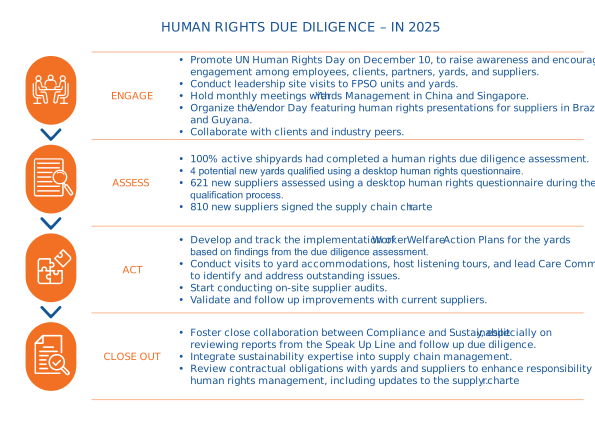
SBM Offshore’s approach to effectively managing human rights centers around its due diligence process, consisting of four key steps: engage, assess, act, and close out. This process is supported by a performance management system that includes action trackers, outcome-monitoring dashboards, and reports submitted for senior management appraisal and approval.
Engagement
SBM Offshore identifies and maps its stakeholders to assess potential human rights risks, recognizing that low-skilled workers and migrant workers among its Tier 1 (direct) suppliers and in construction yards may be particularly vulnerable stakeholder groups. To better understand the exposure to these risks and plan corrective actions, SBM Offshore engages with suppliers and yards through various initiatives, including:
- Meetings with yards’ management teams.
- Leadership site visits followed by discussions at senior management level led by the HSSEQS Director.
- Regional Vendor Days, inviting local suppliers to participate in workshops and discussions on relevant topics, including potential human rights risks. These events occur regularly, such as the annual Vendor Day in Brazil, the biannual Vendor Day in Guyana, and the worldwide Life Day, held annually in all jurisdictions where SBM Offshore operates.
- Collaboration with industry peers and ongoing dialogue to collectively address human rights issues, including regular gatherings of workgroups such as the Dutch Human Rights Practitioner Group.
SBM Offshore considers the outcomes of these engagements when updating its policies and procedures, as they provide valuable insights into the impacts and interests of these main stakeholder groups in its value chain.
Assessment
Despite having established human rights policies and requirements that align with industry best practices, SBM Offshore acknowledges that some activities of its suppliers and subcontractors may occasionally deviate from its expectations – particularly in areas where local regulations and enforcement are limited. To enhance human rights risk management, SBM Offshore applies a mandatory desktop assessment for new suppliers, provides improvement guidance for existing suppliers, and conducts on-site audits along its value chain, with a focus on construction yards.
SBM Offshore conducts regular audits of active yards using both internal certified specialists and external independent consultants. Based on experience with risk monitoring and incidents management, along with human rights due diligence carried out on-site in recent years, SBM Offshore has identified construction yard workers as the most vulnerable to human rights risks, given the composition of the workforce and the nature of the work performed. The assessments have specifically highlighted that workers in Asia and Southeast Asia – especially migrant workers performing manual labor and construction activities in lower-skilled, lower-paid, or subcontracted roles – are more exposed to these risks.
Potential or actual human rights risks are captured in SBM Offshore’s risk management system and monitored regularly. Key risks observed in the yards include:
- Potential exploitation of workers who are charged inappropriate recruitment fees by employment agencies.
- Work overtime and limited rest periods that fail to meet national legislation.
- Inadequate accommodation that fails to meet the basic needs of workers.
In addition to periodic audits, SBM Offshore has integrated human rights assessment into the supplier and yard qualification process, in which prospective partners are screened for alignment with SBM Offshore’s minimum requirements for environmental, human rights and governance risk management.
Act and Close Out
For suppliers, when potential human rights risks are identified through due diligence and periodic audits, SBM Offshore will initially contact the supplier to understand the issues, raise awareness and encourage improvements to prevent and mitigate these risks. This may involve integrating human rights considerations into contract agreement to enhance the suppliers’ internal processes.
For the yards, SBM Offshore collaborates on the development of Worker Welfare Action Plans to address outstanding issues identified after the due diligence assessment. To support this initiative, SBM Offshore has a global team of HSSE and Human Rights advisors who assist yards in implementing the action plan deliverables. Currently, these experts monitor actions related to worker welfare risks in five active yards, meeting frequently with yard management to review progress on implementation and the effectiveness of the actions. Regular interactions in 2025 can include:
- Worker Welfare Listening Tours – regular one-on-one interviews conducted by SBM Offshore with yard workers to assess any emerging employment risks identified in the initial audit. This process involves collecting feedback on any topics related to labor rights violations; topics include passport retention, monetary fines or charged fees, dormitory conditions, among others.
- Care Committee – collaboration between clients and suppliers to address feedback and initiatives from contractors, such as providing additional rest areas, installation of extra fans and additional portable drinking water locations on site.
- Yard Accommodation Visits – inspection of workers’ accommodation for conformity with national legislation, checking aspects such as heating and ventilation, health and fire safety, the provision of minimum space for each worker, access to potable water, sanitary facilities and laundry, cooking facilities, and first aid and medical services, among other basic needs.
Furthermore, SBM Offshore has been improving the contractual obligations specified with construction yards to strengthen the management of human rights on projects. This enhancement includes, in certain cases, appointing a specialized human rights advisor to be present at the yard. This advisor is responsible for managing daily interactions and engaging directly with the workforce.
Grievance Mechanism
SBM Offshore recognizes that having an effective grievance mechanism is essential for upholding human rights, in line with the United Nations Guiding Principles on Business and Human Rights. The primary channel for individuals and third parties to report human rights concerns at SBM Offshore is the Speak Up Line (for details about the channels, procedures and outcomes refer to sections 2.5.2 and 3.4.1). This line is accessible to all stakeholders who may be adversely affected by SBM Offshore’s activities, allowing them to raise concerns and seek resolutions to workplace issues related to SBM Offshore’s operations. This channel is also used to monitor, collect feedback and address raised human rights issues throughout the value chain.
Additionally, SBM Offshore has implemented an operational-level grievance mechanism named the ‘Voice Box’ for its project in Singapore. This mechanism is specifically designed for contractors to raise concerns about labor and human rights issues. The ‘Voice Box’ is accessible via a QR code available on site, enabling workers to confidentially voice concerns or submit positive feedback. Their grievances are addressed directly by the project team or escalated to the yard for resolution. In 2025, the Voice Box contributed to resolving and improving the monitoring of project-specific issues, including food quality, timely payments, work environment, and accommodation.
PERFORMANCE
Capacity Building and Training
SBM Offshore promotes awareness of human rights through onboarding sessions and training, delivering a total of 2,379 training hours by the end of 2025. SBM Offshore provides three key training courses on Human Rights, which were introduced or revised between 2024 and 2025:
- Human Rights Basics – this course is designed to introduce SBM Offshore employees to human rights matters. It includes an introduction to situations that may lead to human rights violations and outlines the measures SBM Offshore takes to mitigate human rights risks in the supply chain.
- Human Rights for Supply Chain – this course aims to equip the supply chain community with the knowledge and skills necessary to understand, identify, and address human rights violations, particularly those involving suppliers.
- Worker Welfare for Yards - this course is tailored for personnel working in a yard environment, which is considered a potential high-risk location.
Additionally, four internal HSSE staff members have obtained certifications in Social Accountability auditing, enhancing SBM Offshore’s capacity to identify human rights risks as SA8000 auditors, increasing the total number of trained auditors to five. The SA8000 Standard is a leading social certification program designed to improve working conditions and uphold fair treatment and respect for the human rights of workers worldwide. This certification not only confirms SBM Offshore’s existing internal knowledge but also expands its ability to monitor and address issues identified through due diligence activities.
Metrics and Targets
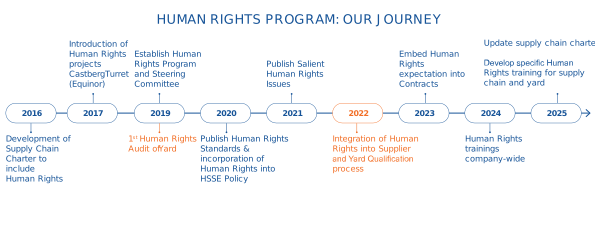
Since 2016, SBM Offshore has communicated its human rights commitments and values to suppliers through its Supply Chain Charter. In 2020, SBM Offshore incorporated its human rights commitments into the HSSE Policy and established its Human Rights Standards. Since then, SBM Offshore has enhanced its due diligence processes for both suppliers and its own operations, as detailed in the Due Diligence and Stakeholder Engagement section. SBM Offshore will continue to communicate its human rights requirements to clients and suppliers to minimize adverse impacts, promote positive effects, and manage material risks and opportunities.
- 100% of active yards have undergone a human rights due diligence assessment;
- 100% of active yards with non-conformity items have an action plan in place;
- 100% of suppliers qualified during the year have signed the Supply Chain Charter1;
- 100% of ABCD2criticality suppliers qualified during the year have been assessed on human rights as part of the supplier qualification process.
Achievement
Supply Chain
In 2025, all 810 qualified suppliers signed the SBM Offshore Supply Charter and were screened according to the procedures implemented by the Global Supply Chain Excellence team. A total of 621 new unique ABCD criticality suppliers were assessed using a desktop human rights questionnaire, resulting in the following human rights risk classifications:
- 620 suppliers were screened as low risk;
- 1 supplier was screened as medium risk;
- 0 suppliers were screened as high risk.
Furthermore, SBM Offshore disqualified one existing supplier following an investigation carried out in 2025, which was prompted by a complaint submitted through the Speak Up line.
New suppliers signing the Supply Chain Charter
2025 | 2024 | 2023 | 2022 | 2021 | |
|---|---|---|---|---|---|
Percentage of new suppliers who signed the Supply Chain Charter | 100% | 100% | 100% | 99.6% | 97% |
Yards
By the end of 2025, all active yards3 had completed a human rights due diligence assessment, resulting in the creation of an action plan with mitigation measures to address identified non-conformities. Among SBM Offshore’s five active yards, four underwent reassessments in 2025 due to business audit requirements, while the fifth was last assessed in 2024. Additional human rights due diligence assessments were conducted at three other yards anticipating activities in 2026.
SBM Offshore also qualified four new yards through a desktop human rights questionnaire, positioning them as potential prospective partners.
Future
In 2026, SBM Offshore aims to enhance its Human Rights Management by organizing training and awareness sessions for suppliers and by continuously improving its auditing practices. SBM Offshore expects to strengthen the ongoing collaboration between the Human Rights, Compliance, and Procurement teams to address human rights issues raised through the grievance mechanism while also promoting the integration of a more sustainable supply chain.